The corrosion crew records a deficiency and the integrity engineer never sees it.
We all want the same thing: zero incidents.
You already run ten pipeline compliance programs. API RP 1173 asks whether they work as one.
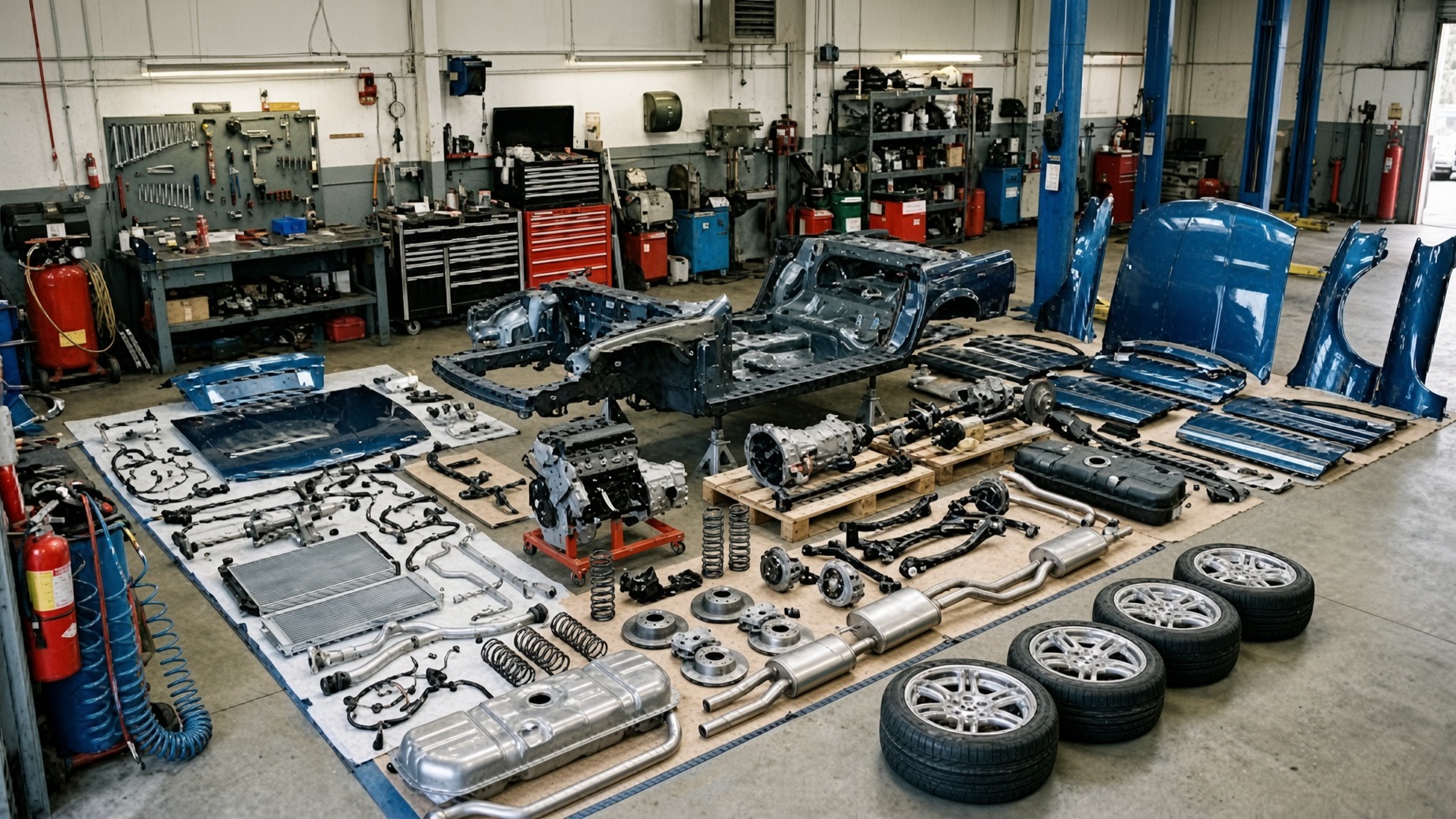
A garage full of car parts is not a car. Eight of the standard's ten elements already have required work behind them. What is missing is not another program document, it is the assembly.
No call required, and nobody outside your company needs to be in the room.
The seams
Three sentences. Nothing in them breaks a rule.
The Operator Qualification Program lists a covered task the O&M Manual no longer describes.
A change to the manual never reaches the training material.
Nothing in any of those sentences breaks a rule, and all of them are risk.
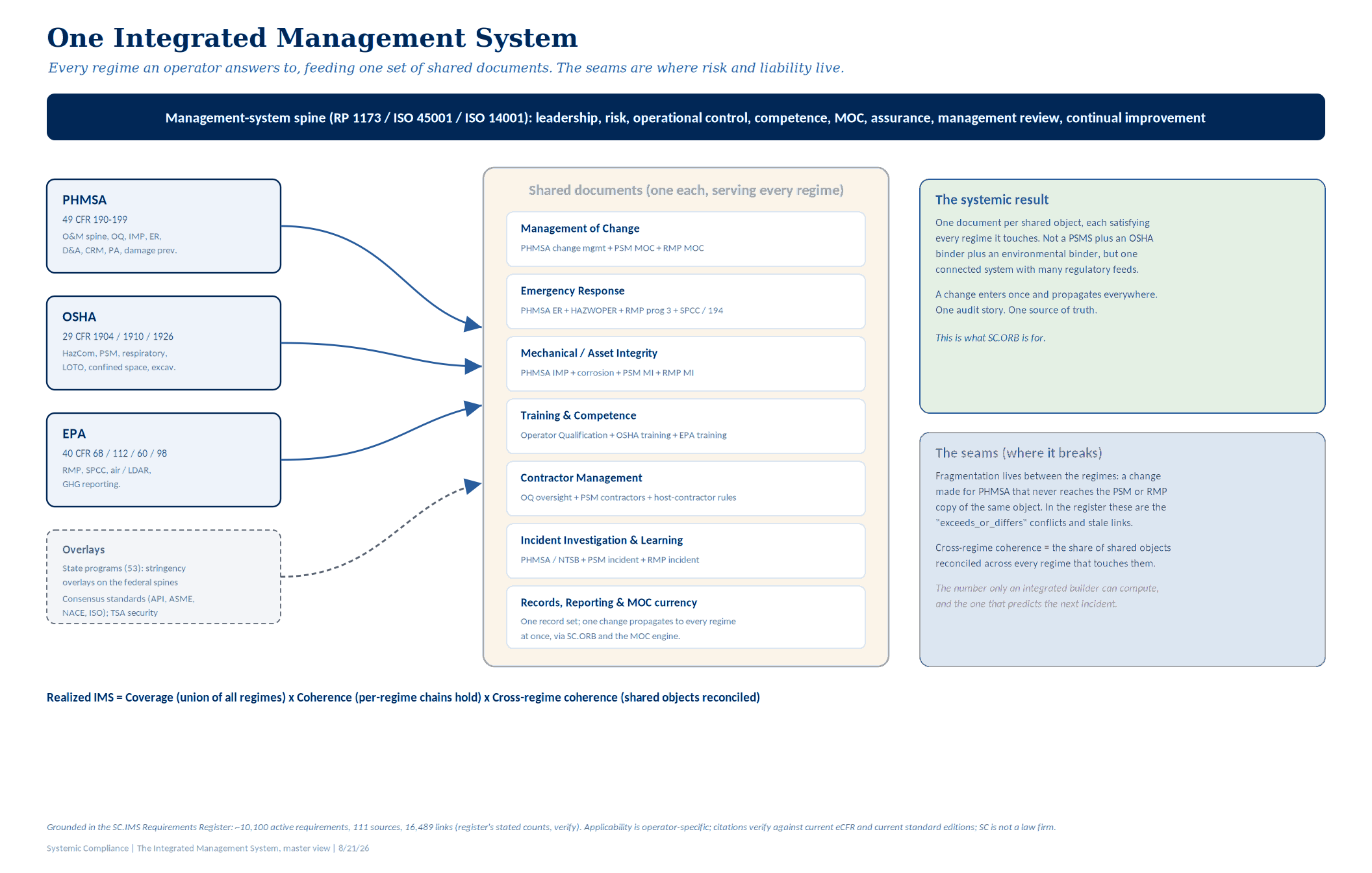
That is almost never a failure of effort. The corrosion crew does its job. The integrity engineer does hers. The information does not move between them. Nobody is negligent and the risk picture is wrong.
Incidents happen at the seams.
What it actually is
A pipeline safety management system is not another program document.
PSMS stands for pipeline safety management system. API RP 1173 is the recommended practice that describes one for pipelines. It is voluntary, and it is not incorporated by reference into Part 192 or Part 195.
You already have roughly ten program documents. Adding an eleventh is not what API RP 1173 asks for.
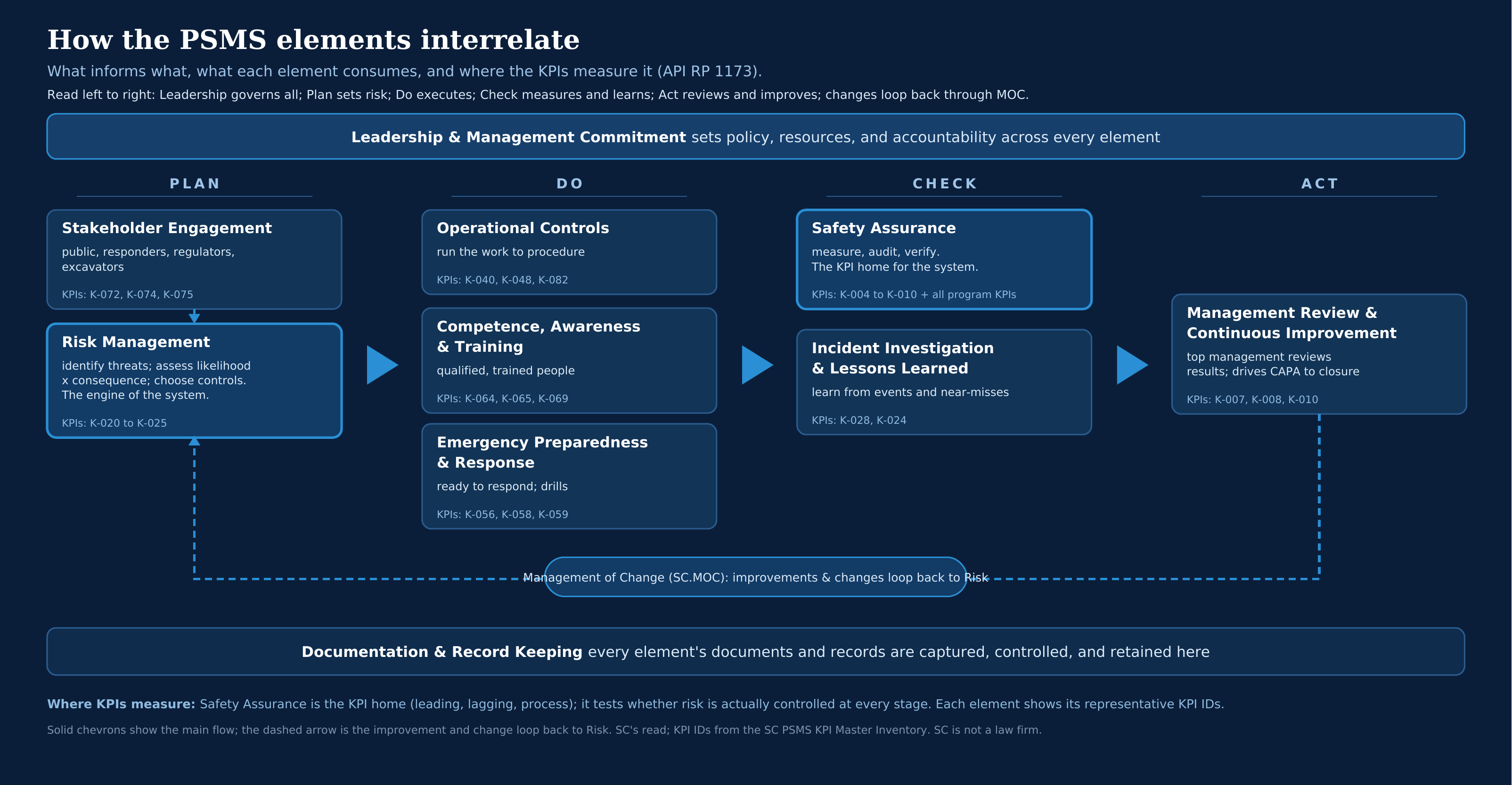
It is a defined way of running the safety side of your business, organized around ten elements and driven by a Plan, Do, Check, Act cycle. Leadership owns safety performance. A risk picture is kept current. Controls reflect that risk picture. Competence and training support the controls. Incident investigation, safety assurance and management review close the loop, so what you learn changes what you do.
Not software. Not a binder. Not a new rulebook. It is the layer of ownership and review that makes the programs you already run behave as one thing.
The record
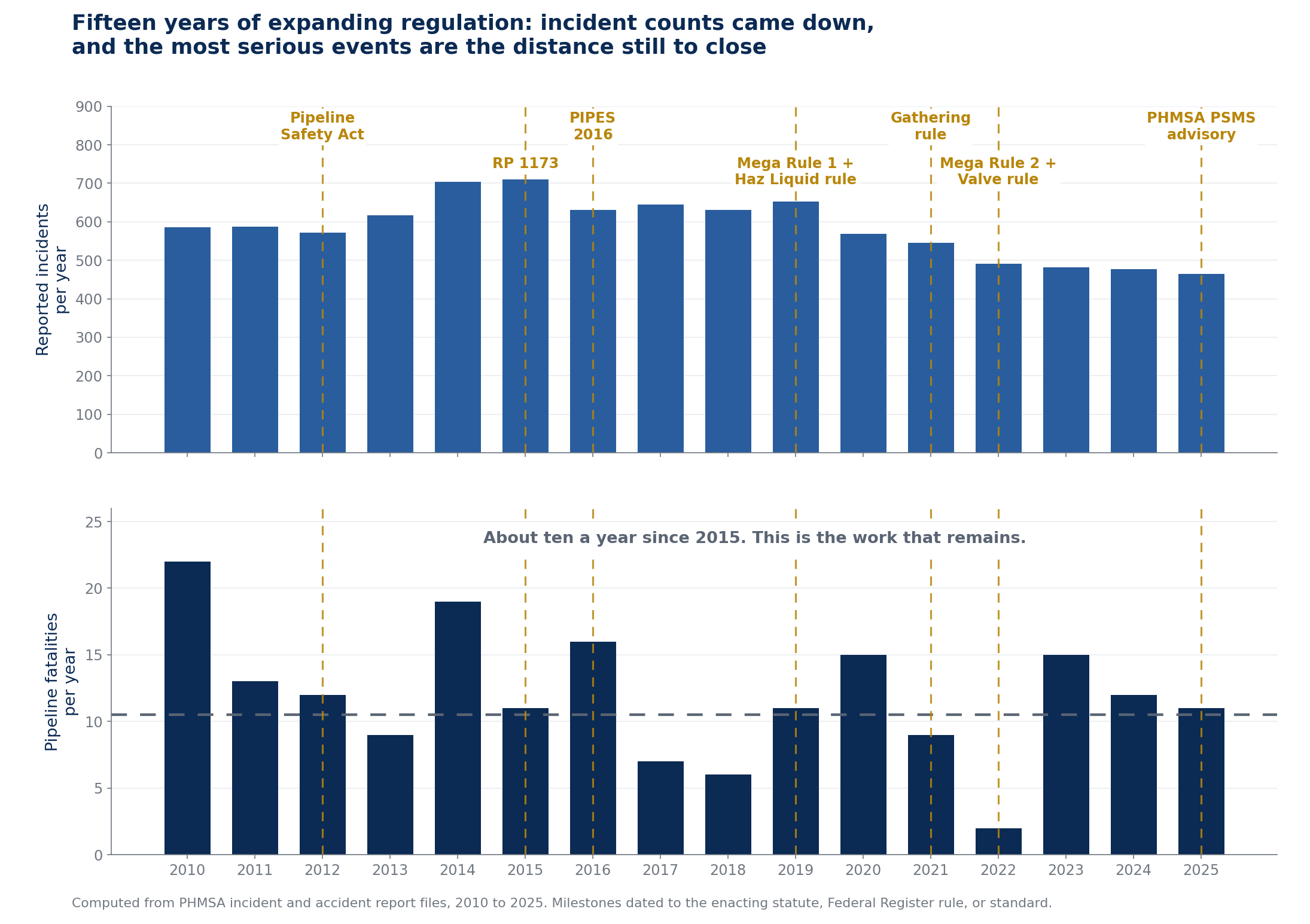
Four institutions. Thirteen years. One direction.
Everyone with standing has now pointed in the same direction, and nobody has made it mandatory.
The NTSB recommends that API develop a pipeline safety management system standard after Marshall, Michigan. Safety Recommendation P-12-17.
API publishes RP 1173. First edition July 2015, reaffirmed April 2023.
Congress directs PHMSA to promote pipeline safety management systems in section 205 of the PIPES Act of 2020.
NTSB issues Safety Alert SA-095, followed by Safety Recommendation P-24-2.
PHMSA issues Advisory Bulletin ADB-2025-01 at 90 FR 13658. It describes serious accidents as an alignment of weaknesses across multiple activities. That describes a failure no single program owns.
We are not going to tell you a mandate is coming. Nobody knows that. Thirteen years of consistent encouragement from the investigator, the standards body, Congress and the regulator is a reasonable thing to plan around, whatever its legal status.
Start from where you are
The system you already have
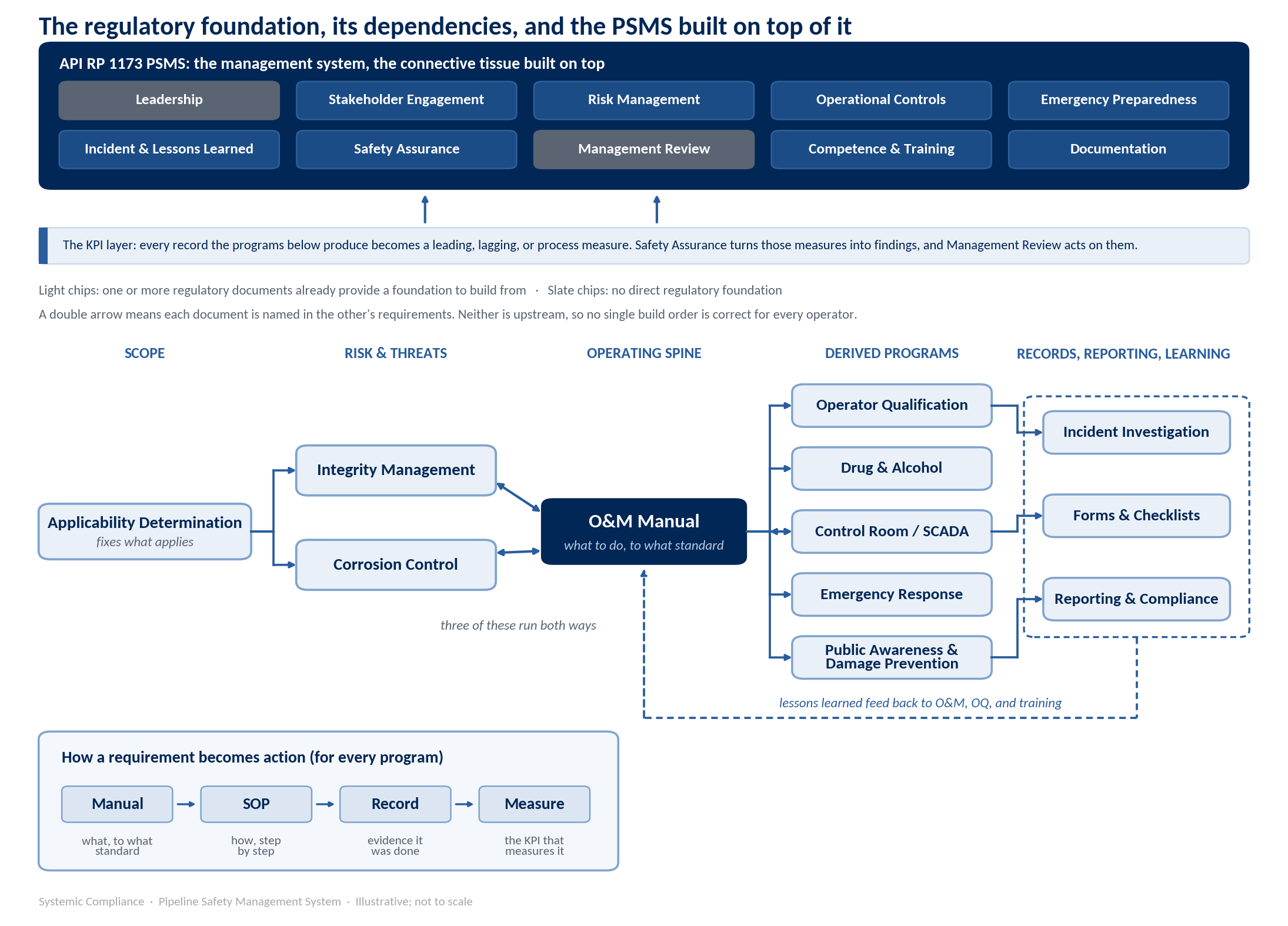
Federal regulation already makes you write roughly ten programs. Map them against the ten elements of API RP 1173 and something useful appears.
Operations and Maintenance Manual
49 CFR 192.605 or 195.402
Emergency Response Plan
192.615 or 195.402(e)
Corrosion control
Part 192 Subpart I or Part 195 Subpart H
Integrity management
192 Subpart O, 192 Subpart P, or 195.452
Operator Qualification Program
192 Subpart N or 195 Subpart G
Public awareness
192.616 or 195.440
Damage prevention
192.614 or 195.442
Control room management
192.631 or 195.446
Drug and alcohol
49 CFR Part 199
Records and reporting
Part 191 or 195 Subpart B
Eight of the ten API RP 1173 elements already have required work behind them. Only two have nothing behind them at all: leadership and management commitment at the front of the cycle, and management review and continuous improvement at the back.
Be careful with that count. Required work behind an element is not the same as a satisfied element. API RP 1173 asks for more than the rules do in nearly every case, so read the eight as a head start, not as credit for eight finished elements.
The compliance paradox
A binder of excellent programs is not a system.
The obstacle is almost never missing documents. It is that the documents you already have do not work together.
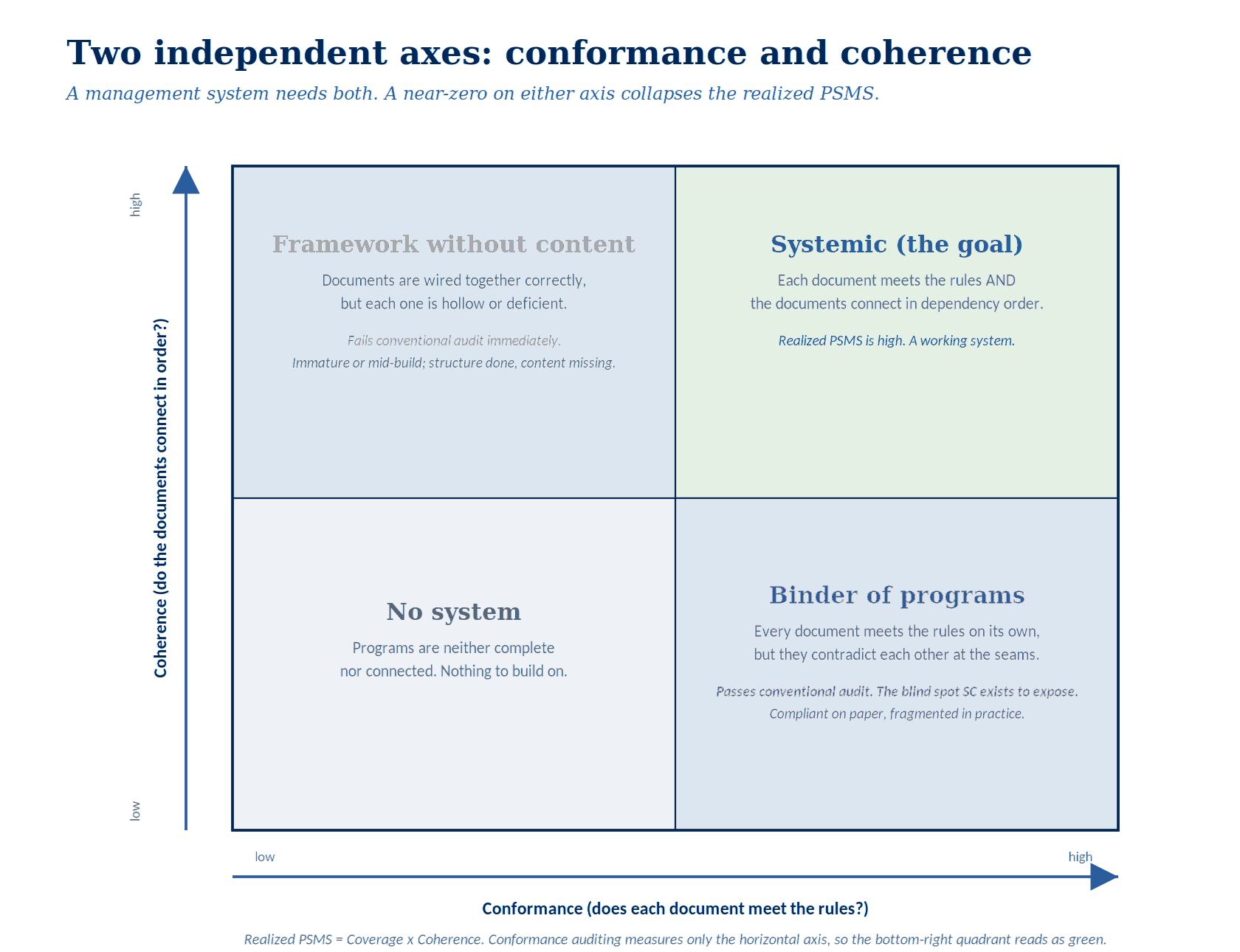
Conventional inspection tests conformance one document at a time. It rarely tests whether a change, decision or record moved across the boundary between programs.
Ten inspections. Ten passes. No car.
The measure nobody takes
Conformance is whether each document is right. Coherence is whether they are right together.
We call it "Coherence". It is a property of the set, not of any document in it, which is why it is invisible from inside any single program.
- Each fact drawn from a requirement is stated in one place.
- Every activity traces back to a requirement and forward to a record.
- A change reaches everything it touches inside a known amount of time.
- No two documents give different answers to the same question.
- Nothing is produced that nobody uses.
- You can tell where you stand without reading every page.
Coherent Partially Integrated Fragmented
How you would know
Three measures, reported separately.
Averaging them hides the problem. An honest report says which part is which.
Conformance
Whether each document meets the rules that govern it. This is the one an audit already covers thoroughly.
Coherence
Whether the documents agree with each other and whether information moves between them. Almost nobody measures this today.
Effectiveness
Whether the system is actually working. More of this can be read from records you already keep than you might expect.
You can have high conformance and low coherence. That is the common case, and it is dangerous because it passes a conventional audit. Leave it in place, and the management system you build on top inherits the same gaps.
Do this without us
Get your own people in a room.
Nobody outside your company needs to be in that room.
Take the ten documents. For each one, list what it consumes and what it produces. That is the whole exercise.
If you do it, you will quickly find both problems this page is about: a record somebody produces on a schedule that nobody downstream ever reads, and a single question that two documents answer differently.
| Program document | What it consumes | What it produces |
|---|---|---|
| Operations and Maintenance Manual | ||
| Emergency Response Plan | ||
| Corrosion control | ||
| Integrity management | ||
| Operator Qualification Program | ||
| Public awareness | ||
| Damage prevention | ||
| Control room management | ||
| Drug and alcohol | ||
| Records and reporting |
Get the one-page worksheet
No call required. Ask for a copy by email, or print the complete worksheet above.
Where we fit
Systemic Compliance builds the capability this page argues for.
We build and sell this capability. You should know that before you weigh the argument rather than discover it afterwards.
Start here
SC Diagnostic
A structured read of your programs that shows what applies to you, where the seams are, what depends on what, and where information is failing to move.
- Background and scope
- Applicability determination with citations
- Source-traceable gap analysis
- Scorecard with measures shown separately
- A Now, Next, Later remediation roadmap
The diagnosis stands alone. You own it and you can hand it to anyone. If the roadmap names work you decide to take on with our help, the Diagnostic fee becomes a credit balance against it.
Management system work
Design, implement and keep current a real management system and the regulatory programs beneath it. A PSMS manual ties the programs together and documents all ten API RP 1173 elements.
Consulting
Project based or ongoing work, from a Diagnostic through full program builds and inspection readiness.
Contractor and workforce management
Qualify and manage your contractors and workforce against one baseline built to your O&M procedures.
Training and competence
Training built from your procedures for the whole role, not just the task.
Behind the work is an intelligence framework for what applies, how requirements connect, and what evidence proves the work. We are advised by former regulators, pipeline operators and contractors: people who have followed, inspected and enforced these rules.
Fair questions
The objections we expect, answered here rather than later.
We would rather answer these ourselves than have someone else raise them first.
01This is API RP 1173 with different words.
Partly fair, and the part that is not fair is the part that matters. API RP 1173 specifies a management system and assumes an underlying set of programs. Coherence is a property of that underlying set. The recommended practice does not specify a dependency artifact, define propagation completeness, or provide a taxonomy of interface failures.
02Is this just follow your procedures? 192.605 and 192.13(c) already require it.
Yes, and that is the point, not the flaw. The authority is already there, which is why coherence needs no new rule. Follow your procedures is the hook. The dependency map is what lets it find the seam instead of the missing sentence.
03Coherence just becomes another checkbox.
This is the objection we have the least good answer to, and we will not pretend otherwise. The safeguard is to keep the measure tied to named interfaces, actual records, and evidence that information moved.
04You have not shown that incoherence causes fatalities.
Correct. We have not. That is a well supported hypothesis, not a demonstrated causal chain, and publishing it as more than that would be the same error this argument criticizes.
05You cannot enforce a quality property.
Regulators already make quality judgments about adequate procedures. Coherence makes the judgment repeatable. Two documents either contradict each other or they do not, and an output either has a consumer or it does not.
06Small operators cannot afford this.
The smallest operators have the fewest documents and the simplest maps. The exercise on this page is the version a two person operation can actually do.
07We already have a system. We have binders.
Static documents are not proof of field execution. The question is not whether the binder exists. It is whether a change to one document reached the other nine.
08We passed our last inspection.
Every finding was correct. That is the uncomfortable part. A clean inspection checks each document. An incident tests whether they hold together.

Next step
A twenty minute conversation, not a proposal.
Tell us what you already run and what is coming up. If a Diagnostic is not the right thing for you, we will say so.
COMPLIANCE SHOULD BE SYSTEMIC.
sales@systemic-compliance.com